
3. Mucalindakathā (The Account of Mucalinda)
Original text: World Tipitaka Edition
Pali text (click to view)
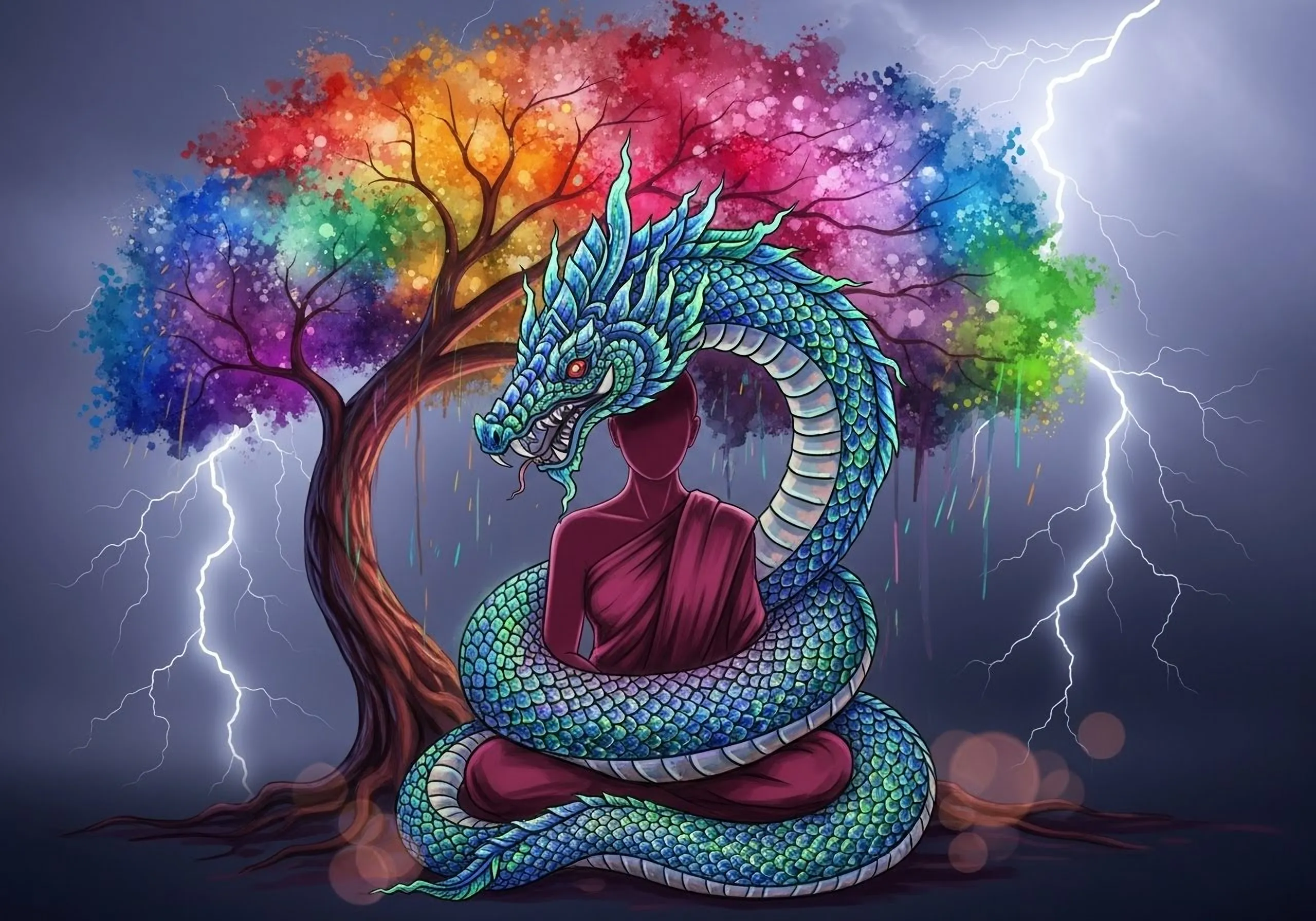
(5.)17. Atha kho bhagavā sattāhassa accayena tamhā samādhimhā vuṭṭhahitvā ajapālanigrodhamūlā yena mucalindo tenupasaṅkami, upasaṅkamitvā mucalindamūle sattāhaṃ ekapallaṅkena nisīdi vimuttisukhapaṭisaṃvedī. Tena kho pana samayena mahā akālamegho udapādi, sattāhavaddalikā sītavātaduddinī. Atha kho mucalindo nāgarājā sakabhavanā nikkhamitvā bhagavato kāyaṃ sattakkhattuṃ bhogehi parikkhipitvā uparimuddhani mahantaṃ phaṇaṃ karitvā aṭṭhāsi— “mā bhagavantaṃ sītaṃ, mā bhagavantaṃ uṇhaṃ, mā bhagavantaṃ ḍaṃsamakasavātātapasarīsapasamphasso”ti. Atha kho mucalindo nāgarājā sattāhassa accayena viddhaṃ vigatavalāhakaṃ devaṃ viditvā bhagavato kāyā bhoge viniveṭhetvā sakavaṇṇaṃ paṭisaṃharitvā māṇavakavaṇṇaṃ abhinimminitvā bhagavato purato aṭṭhāsi pañjaliko bhagavantaṃ namassamāno. Atha kho bhagavā etamatthaṃ viditvā tāyaṃ velāyaṃ imaṃ udānaṃ udānesi—
18. “Sukho viveko tuṭṭhassa,
sutadhammassa passato;
Abyāpajjaṃ sukhaṃ loke,
pāṇabhūtesu saṃyamo.
19. Sukhā virāgatā loke,
kāmānaṃ samatikkamo;
Asmimānassa yo vinayo,
etaṃ ve paramaṃ sukhan”ti.
20. Mucalindakathā niṭṭhitā.
Summary
Section titled “Summary”After emerging from seven days of samādhi (mental composure), the Bhagavā spent another seven days at the Mucalinda tree experiencing the bliss of liberation (vimuttisukhapaṭisaṃvedī). During this period, an unseasonal storm arose, prompting Mucalinda, the nāga king, to protect the Bhagavā by coiling around his body and spreading a hood over his head for seven days. Once the storm cleared, Mucalinda transformed into a young man and paid homage. In response, the Bhagavā uttered an udāna (inspired utterance) extolling the happiness of viveka (solitude) for the content who have heard the Dhamma, abyāpajja (non-affliction) towards beings, virāgatā (dispassion) from sensual pleasures, and identifying the dispelling of asmimāna (the conceit ‘I am’) as the supreme happiness.
Diagram
Section titled “Diagram”sequenceDiagram
participant Br as Mucalinda
participant Bg as Bhagavā
Note over Bg: Sits at Mucalinda tree root for 7 days,<br>experiencing vimuttisukha (bliss of liberation)
Note over Bg: Great unseasonal storm arises<br>(7-day rain, cold winds, gloom)
Note over Br: Mucalinda, nāga king, emerges<br>Encircles Bhagavā's body 7 times with coils<br>Forms great hood above Bhagavā's head<br>Protects Bhagavā
Br->>Bg: "Let not the Bhagavā be cold, let not the Bhagavā be hot, <br> let not the Bhagavā be touched by gadflies, mosquitoes, wind, sun, or creeping things."
activate Bg
Note over Br: When storm finishes, becomes young man
Bg->>Br: Utters Udāna (Inspired Utterance)
deactivate Bg
Note over Br,Bg: Happy is viveka (solitude) for one who is content,<br> who has heard the Dhamma (Teaching) and sees<br>Happy is abyāpajja (non-affliction) in the world,<br>restraint towards living beings.
Note over Br,Bg: Happy is virāgatā (dispassion) in the world,<br>the overcoming of kāmā (sensual pleasures)<br>The dispelling of asmimāna (the conceit 'I am')<br>this indeed is the supreme happiness.
(5.)
17. Then, indeed, the Bhagavā, after the passing of seven days, having emerged from that samādhi (mental composure), from the root of the Ajapāla banyan tree, approached where the Mucalinda tree was. Having approached, he sat at the root of the Mucalinda tree for seven days in one cross-legged posture, experiencing the bliss of liberation (vimuttisukhapaṭisaṃvedī). Now, at that time, a great unseasonal storm cloud arose, a seven-day rain, with cold winds and gloom. Then, indeed, Mucalinda, the nāga (serpent deity) king, having come out from his own abode, encircled the Bhagavā’s body seven times with his coils, and having made a great hood above his head, he stood, thinking, “Let not the Bhagavā be cold, let not the Bhagavā be hot, let not the Bhagavā be touched by gadflies, mosquitoes, wind, sun, or creeping things.” Then, indeed, Mucalinda, the nāga king, after the passing of seven days, knowing the sky to be clear and free of clouds, having unwound his coils from the Bhagavā’s body, having withdrawn his own form and created the form of a young man, stood before the Bhagavā with clasped hands, paying homage to the Bhagavā. Then, indeed, the Bhagavā, understanding this matter, at that time uttered this udāna (inspired utterance):
18. “Happy is viveka (solitude) for one who is content,
who has heard the Dhamma (Teaching) and sees;
Happy is abyāpajja (non-affliction) in the world,
restraint towards living beings.
19. Happy is virāgatā (dispassion) in the world,
the overcoming of kāmā (sensual pleasures);
The dispelling of asmimāna (the conceit ‘I am’),
this indeed is the supreme happiness.”
20. The acount of the Mucalinda tree is finished.
Commentary
Section titled “Commentary”The “unseasonal storm” and the protective “Mucalinda nāga” (often translated as “dragon king”) can be interpreted as a symbolic depiction of navigating intense adversity while maintaining this liberated awareness. From a rational perspective, Mucalinda’s intervention isn’t a literal supernatural event but could represent the powerful, almost instinctual, self-regulating and protective capacity of a deeply concentrated and equanimous mind. The “coils” and “hood” vividly portray how such a state can feel encompassing and shielding from external or internal disturbances. Mucalinda’s later transformation and homage signify an intuitive recognition and integration of this profound protective experience.
The udāna articulates the core insights from this state. Viveka (solitude) is valued for the contentment and clarity it affords, allowing for direct experiential insight (“sees” the Dhamma). Abyāpajja (non-affliction) describes the lived experience of benevolence. Virāgatā (dispassion) refers to the phenomenological freedom from the drive of sensual pleasures (kāmā). The “dispelling of asmimāna (the conceit ‘I am’)” is paramount. Psychologically, this is the deconstruction of a fixed, reified self-concept. The realisation that the “I” is a construct, and the subsequent release from the anxieties and attachments bound to it, constitutes the “supreme happiness.”
In Gombrich - How Buddhism Began: The conditioned genesis of the early teachings (2006) (Gombrich, 2006), Gombrich notes:
Shortly after his Enlightenment, the Buddha is sitting in the bliss of meditation when a great storm arises (Vin I, 3). To protect him, the nāga king Mucalinda comes and wraps his coils round the Buddha and spreads his hood over the Buddha’s head. When the storm has passed, he takes the form of a young brahmin and renders homage to the Buddha. He does not say anything, and we cannot tell why he takes human form; but this episode too has the air of being an allegory of religious rivalry.
(Levman, 2014) explains that the reference to the nāga king Mucalinda may be linked to serpent worship amongst indigenous people. Similar to the inclusion of tree references, the intention by the author/compiler of the Khandhaka is to make Buddhism attractive to the local population by incorporating local worship practices.
(Levman, 2014) writes:
In the third week after his enlightenment, the Buddha re-experienced the bliss of liberation under a mucalinda tree (Barringtonia Acutangula, mangrove or Indian oak tree; a non-Aryan name per KEWA, vol. 2, 649), and when a storm arose Mucalinda, the serpent king — who was evidently also the tree deity — came and protected the Buddha by wrapping his coils seven times around him and covering his upper head with his hood; there he remained for seven days, protecting him from the inclement weather. This story is told in the Theravādin Khandaka (at Vin I 0311–31), considered by many to be a work containing some of the earliest layers of Buddhist tradition (Waldschmidt 1944–48, 335–337; Frauwallner 1956, 153; Pande 1974, 98; disagreeing, Lamotte 1988, 178–179). The earliest representation we have of the nāga cult occurs on the southern gate at Bhārhut where the Buddha is worshipped by the nāga king Erapato (Vogel 1926, 39; plate 3 facing page 40). The Mucalinda incident is alluded to on the western gateway at Sāñcī where the Buddha is represented by an empty platform underneath the mucalinda tree, and the nāga by a man wearing a five-part snake hood under the platform. A scene depicting the worshipping of the five-headed nāga is chiselled on Sāñcī’s eastern gateway (Fergusson 1868, 113). In the later Mahāvastu, the Mucilinda legend is also told, but the role of the nāgas is embellished: the Buddha spends the fourth week after his awakening in the abode of the nāga king Kāla and the fifth week in Muclinda’s abode where he is protected against unseasonable weather (Mvu III 30010–30107). On his way to set the wheel of Dharma turning at Benares, the Buddha is escorted by the Sudhāvāsa deities, the Suvarṇas, and the Nāga kings, and lodged along the way by the yakṣas Cunda and Kandha, and by the nāga kings Sudarśana and Kamaṇḍaluka, as well as an unidentified householder (Mvu III 324–328). In the Amarāvatī monastic site (second century BCE) in south-eastern (Dravidian) India, the Buddha is represented as a nāga on a stūpa (Stern and Benisti 1961, plates 8a, 15b and 40b; the nāga in the former plate is contemporary with some of the earlier bas-reliefs of Sāñcī, p. 73).
Snake veneration was an aboriginal, not an Aryan cult — there is no trace of serpent worship in the Vedas and snakes do not become an important Aryan religious theme until the Mahābhārata, where they are usually treated as dangerous enemies (Fergusson 1868, 58; Macdonell 1897, 153); it was however, evidently part of Buddhism from the very beginning and an integral part of its founding mythology; the nāgas were both worshippers of the Buddha and important protective deities which were themselves venerated. In what is perhaps one of the earliest works of the canon (the Sutta-nipāta), the Buddha is addressed as a nāga as a mark of respect; however, by the time the commentary was written (fifth century CE), this snake epithet is something of an embarrassment (Norman 2006, 191–192), and attempts are made to explain away the snake connection with fake etymologies: nāgan ti punabbhavaṃ n’ eva gantāraṃ, atha vā āgun na karotī ti pi nāgo, balavā ti pi nāgo, taṃ nāgaṃ (Pj II 20812–13: ‘he is called “nāga” since he does not go to a new birth [taking the ga- in nāga as derived from the MI verb gam, ‘to go’ with na- as the negative adverb], or he does not commit a fault [na-āgu, ‘no, fault’] and also since he is strong’. In fact, the etymology of nāga is not well understood and may or may not be of IA origin. The meaning of the words nāga and yakkha/yakṣa seems to have worsened over time, and in some instances they also represented harmful demons. Whether this is an example of linguistic pejoration or ambiguity with respect to a nāga’s moral status is unknown. Later in the Khandaka story, for example, where Mucilinda protects the Buddha, the Buddha subdues a savage nāga king who lived in the fire room of the jaṭila (matted hair ascetic) Kassapa (Vin I 2410–2538).
Snake-worship is generally believed to be an aboriginal cult associated with a Mongolian or Tibeto-Burmese people who occupied North India before the advent of the Aryans (Minor 1981, 519). The nāgas (serpents or cobras) were also another pejorative name the Aryans used for the eastern tribes (along with asuras and dasyus), and the cobra is to this day one of the totems of the Munda-speaking tribes of Jarkhand (Kosambi 1965, 86; Singh 1994, 850).
Other opinions
Section titled “Other opinions”- Gombrich - How Buddhism Began: The conditioned genesis of the early teachings (2006) (Gombrich, 2006)
Gombrich posits a historical rivalry between early Buddhism and the pre-existing cult ofnāga(supernatural serpent) worship, a theory supported by both ambiguous scriptural narratives and archaeological evidence of ancientnāgashrines. While one story depicts thenāgaking Mucalinda cooperatively protecting the Buddha, another from the Vinaya explicitly bars anāgafrom ordination, stating it lacks the capacity for spiritual progress within the doctrine. The author suggests that Buddhists engaged in a “contest” by strategically appropriating the termnāga, which was also used metaphorically as an honorific for enlightened monks. By re-definingnāgaas one who commits no “offence” (āgu), Buddhists infused their rival’s term with a new, superior meaning, effectively arguing that “theirnāgas were better.” This linguistic reappropriation would also explain the origin of later, otherwise confusing customs, such as the Sri Lankan practice of calling ordination candidates ‘nāga’. - Levman - Cultural Remnants of the Indigenous Peoples in the Buddhist Scriptures (2014) (Levman, 2014)
Bryan Levman’s article argues that Buddhist scriptures contain significant cultural remnants from India’s indigenous Munda, Dravidian, and Tibeto-Burman peoples, which have been obscured by a later “brahmanization” that historicized the Buddha within the dominant Indo-Aryan (IA) tradition. The author identifies this indigenous influence by examining the hostility between IA immigrants and eastern ethnic groups like the Buddha’s Sakya clan, whose distinct socio-political organization (gaṇasaṅgha), rejection of the Brahmanical class system, and non-Aryan marriage customs are evident in the texts. Furthermore, key Buddhist concepts and practices are traced to autochthonous roots, including the idea of the Mahāpuruṣa (Great Man), the veneration of trees and serpents (nāgas), the culture of sacred groves, and the unique funeral rites described for the Buddha’s parinibbāna, all of which differ significantly from Vedic norms.
Go to previous page (2. Ajapālakathā) / Go to parent page (Khandhaka) / Go to next page (4. Rājāyatanakathā)